Open post

Symposium by the Sea Branding

When I started at the EMLRC in 2018, FCEP's annual meeting and conference, Symposium by the Sea, was lacking a brand identity. The conference had been called that since the 1980s, but visual branding varied year to year. When it was my turn to brand the conference in 2019, I chose to incorporate the "sea" into designs instead of beaches, which had been used in the past. The turtle was well received by attendees and has now become the "mascot," if you will, for FCEP's annual conference.


View on-site signage for Symposium by the Sea:

Open post

Florida’s EM Residency Programs Guide

Over the past five years, Florida has experienced unprecedented growth in emergency medicine residency programs. Keeping up with the rapid expansion of programs had been difficult without an online guide.

EMpulse Magazine reserves space for each Florida EM residency program to submit a quarterly update. This fosters collaboration among organizations and keeps FCEP members up-to-date on the latest research and happenings at each program. Many FCEP members work as faculty at these residency programs or are alumni.

When developing fcep.org, I decided to create an online guide for Florida's EM residency programs. I did some research to see if anything already existed, but there was nothing specific to Florida. The guide simply lists each program, divided by region, with their main hospital graphic, location, and a button to learn more. Each program has its own page that lists basic information, a button to the program's website, and a list of the EMpulse Magazine articles their program has produced.

The page was an immediate hit. Since April 15, 2021, the page has received 3,979 unique page views (as of writing this on 11/18/22) and is the #1 organic result on Google when searching for "Florida emergency medicine residency programs." It is fcep.org's #5 top performing page of all time, and the page is viewed at least 40 times every day. I have learned that residents and medical students discover FCEP through this page, which was a goal: driving new users, who aspire careers in emergency medicine, to our website.

Open post

FCEP’s Weekly eNews

Every week, in partnership with Multiview, I produce FCEP's Weekly eNews that reaches all FCEP members and subscribers who choose to opt-in. The newsletter promotes EMLRC and FCEP news and events, pediatric-specific announcements from the Florida PEDReady Program, Florida health policy news, ACEP news, and other news related to emergency medicine. I am responsible for finding news articles and summarizing main points into blurbs, which I send to an editor at Multiview who codes it into the newsletter and sends it out to subscribers. I also write all in-house marketing content from EMLRC/FCEP.

This enewsletter boasts a 76% or higher open rate on any given week.

Multiview also helps solicit advertisements for our enewsletter. I also design banner ads promoting EMLRC/FCEP content.

Open post

50 Years, 50 Voices

In 2021, the Florida College of Emergency Physicians (FCEP) membership association turned 50. We celebrated with a commemorative logo and history project called 50 Years, 50 Voices.

  1. The 50 Years, 50 Voices Tribute to Emergency Medicine is a 34-minute video comprised of 26 interviews with FCEP members. A videographer was hired to film interviews, our executive director interviewed members, and I created the narrative for the final product after watching and transcribing each interview. I weaved together soundbites from each interview and the videographer cut and edited footage appropriately. The video was revealed at a dinner event during FCEP's annual meeting, Symposium by the Sea 2021.
  1. A historical timeline of emergency medicine's founding and evolution was also printed in EMpulse Fall 2021 Magazine and published online. It was my responsibility to sift through old photos in our closet, identify and scan the best in, research main events, and write the timeline. A graphic designer assisted me with the timeline's design for signs at Symposium by the Sea 2021, which was then duplicated appropriately for the magazine and online hosting by me.
Open post

EMpulse Online

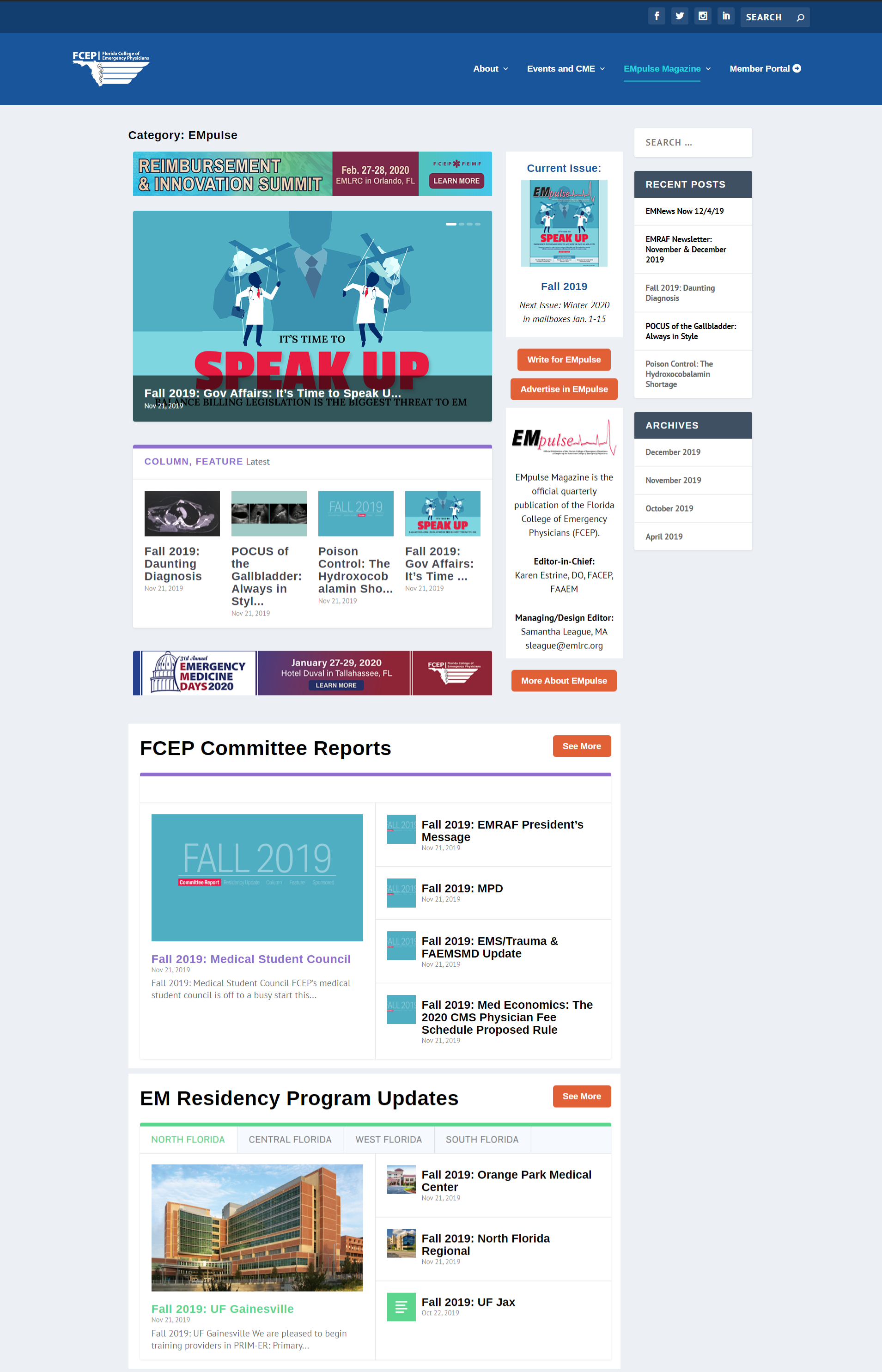
In December 2019, I designed and launched fcep.org, a website for the Florida College of Emergency Physicians. Their content was previously hosted on emlrc.org, making it hard for members to find. A big feature of fcep.org is EMpulse Online: where articles from EMpulse Magazine are hosted like a standard news service. Before this, 27 volumes of EMpulse Magazine were only produced in print.

EMpulse Online drives significant traffic to fcep.org. The top two performing pages are EMpulse scientific articles, and many other EMpulse articles consistently show up in the top 20 pages. This extends the reach of each author's content and FCEP's reputation as an authoritative voice in emergency medicine.

Each article is published as a blog post and organized with categories. I use a Guest Authors plugin to appropriately credit each author in the metadata. Where appropriate, articles contain hyperlinks to references and external resources. Some articles also contain banner ads, supplied by sponsors or designed by me for company promotions.

Each issue is accessible from the fcep.org menu at: EMpulse Magazine -> Issues. Sections from the magazine are also identified through the EMpulse Magazine dropdown menu.

Open post

EMLRC Conferences and Events

Symposium by the Sea

FCEP's annual meeting and summer conference (target audience: emergency physicians)

SBS 2020 Sponsor & Exhibitor Prospectus | 2019 Conference Program | 2019 Sponsor & Exhibitor Prospectus


CLINCON

EMLRC's annual conference and competition (target audience: EMS)

CLINCON 2020 Sponsor & Exhibitor Prospectus | CLINCON 2019 Conference Program | CLINCON 2019 Sponsor & Exhibitor Prospectus


Emergency Medicine Days

FCEP's annual advocacy event in Tallahassee during Florida Session (target audience: FCEP members)

2020 Talking Points for Legislators


Life After Residency

FCEP's annual retreat for emergency resident physicians nearing graduation (target audience: Florida PGY-3s)

2020 Sponsor Prospectus

Open post

PEDReady PEARL Newsletter

The Florida PEDReady Program provides free resources on caring for children in emergency situations to EMS agencies and emergency departments. The EMLRC hosts this webpage of resources—I design and update content, which is provided by Dr. Phyllis Hendry, the Florida EMS for Children (EMSC) Chair.

In spring 2019, Dr. Hendry approached me about launching a weekly enewsletter dedicated to pediatric emergency education. She decided on naming it the PE2ARL, which stands for "pediatric emergency education, advancement, resources and literature." The first issue launched April 5, 2019 and has continued weekly ever since. The logo and overall branding was done by Raina Davidman, Dr. Hendry's program assistant at the time, and the layout was designed by me.

Examples of the PEARL:

Open post

OLP Course Profiles

One of my last projects at the Academy of Our Lady of Peace (OLP) was creating a section on our website for the Curriculum Guide. Prior to this year, our Curriculum Guide and course offerings were only available in a 70+ page, non-interactive PDF, and the new Director of Curriculum & Instruction wanted to provide a more accessible and user-friendly way for families to navigate course offerings.

We started planning in July 2017 and she came to me with ideas from other school websites. The following things were important:

  • Every department and course needed to have its own page
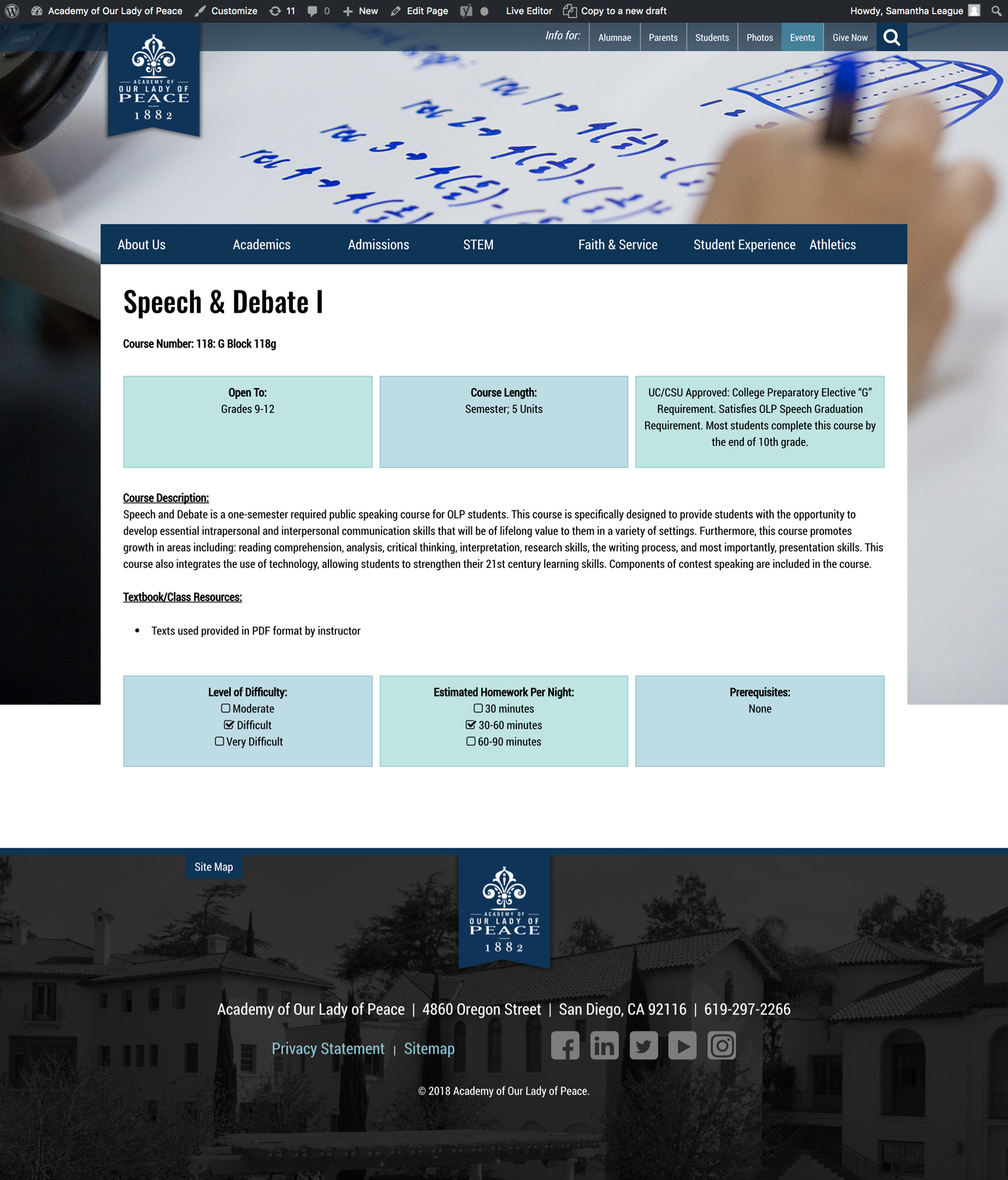
  • Each course needed to have a table that noted the level of class difficulty, amount of homework per night and prerequisites
  • The process of collecting and transferring information into webpages needed to be as simple as possible because everything is subject-to-change every year

Layout & Design

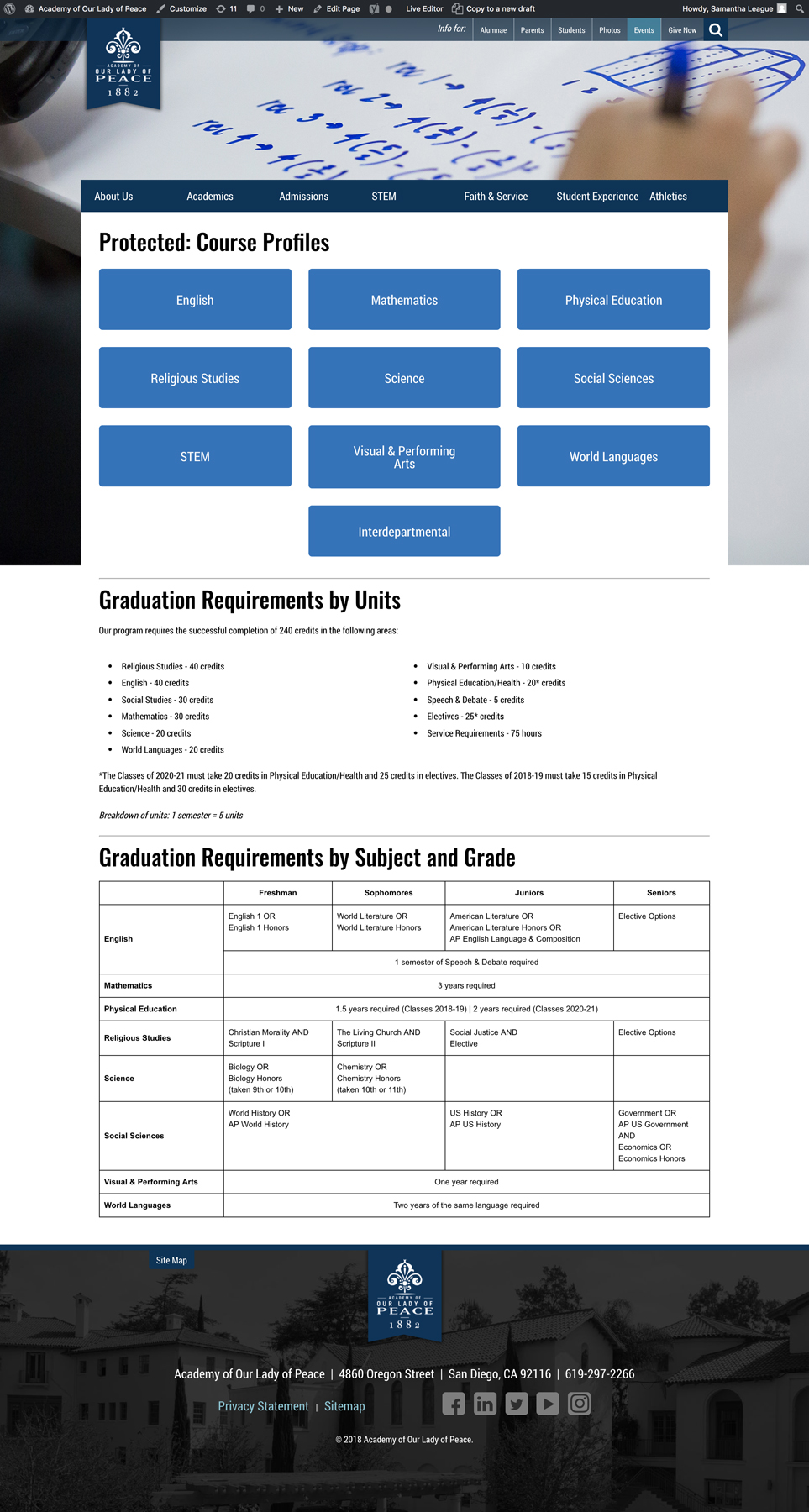
When families click on "Course Profiles" under our Academics tab, they'll land on the Course Profiles Homepage, which has 1) a button to each department, 2) graduation requirements by units, 3) graduation requirements by subject and 4) a PDF version of everything to download and/or print (forthcoming).

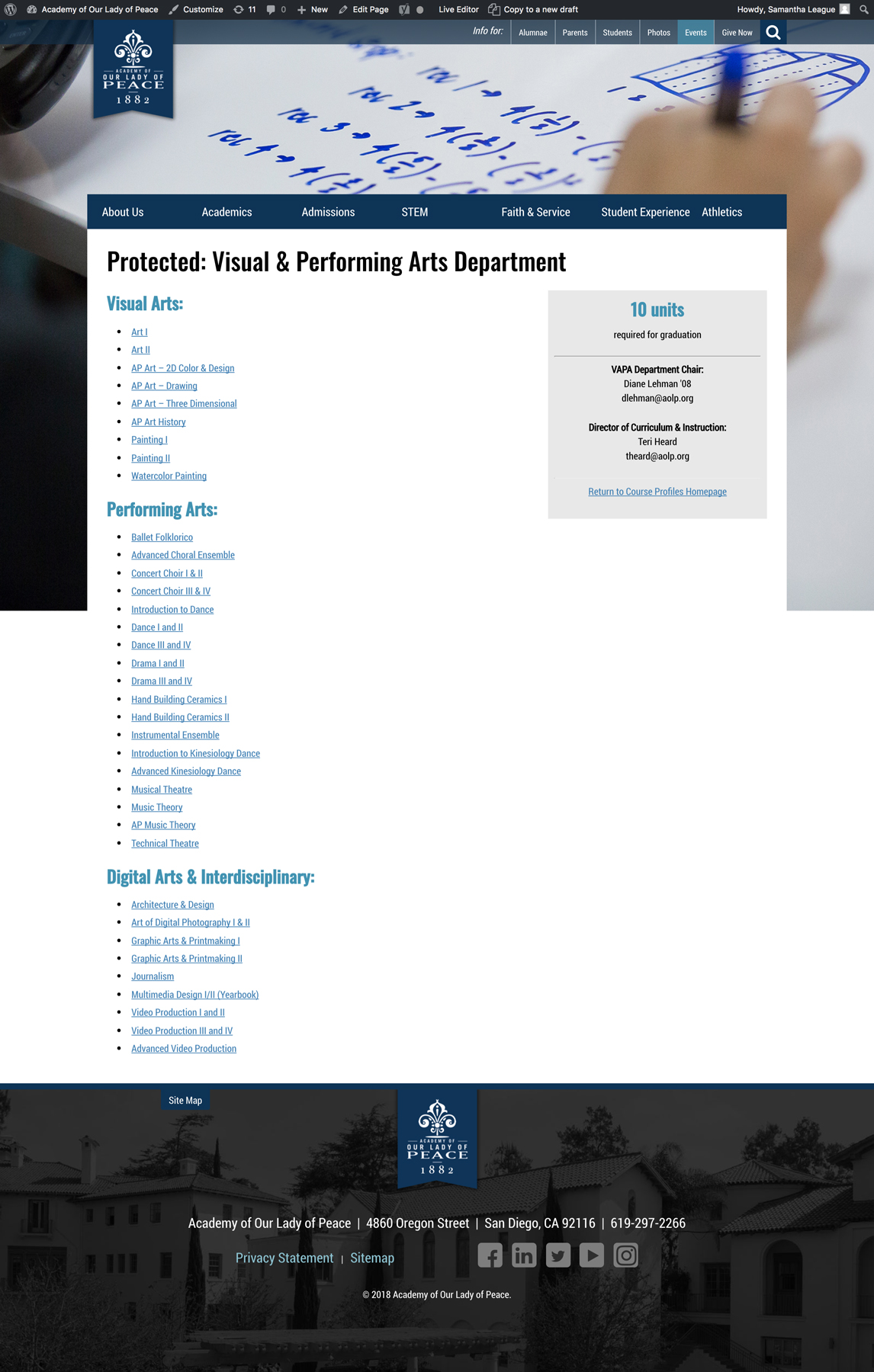
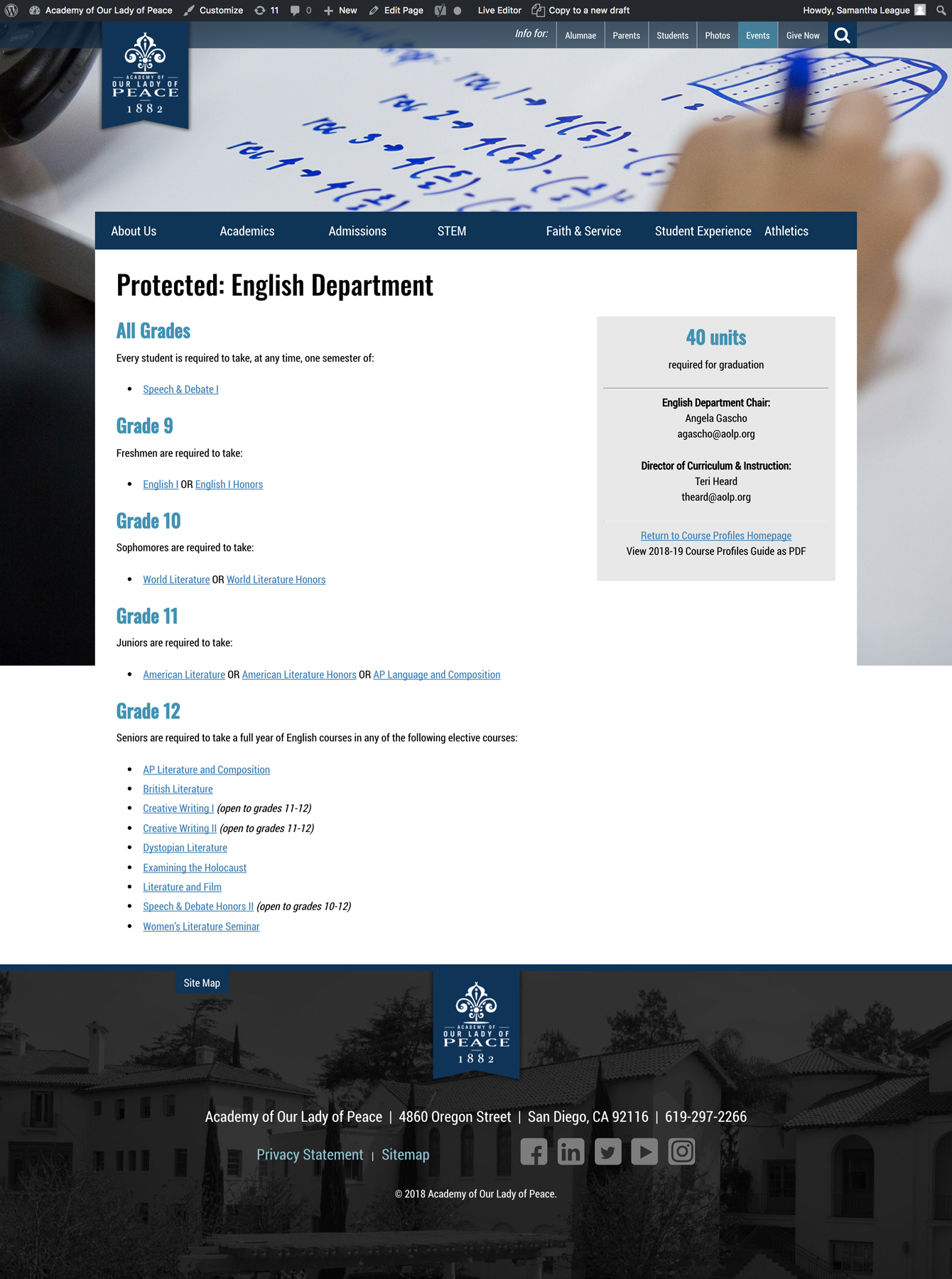
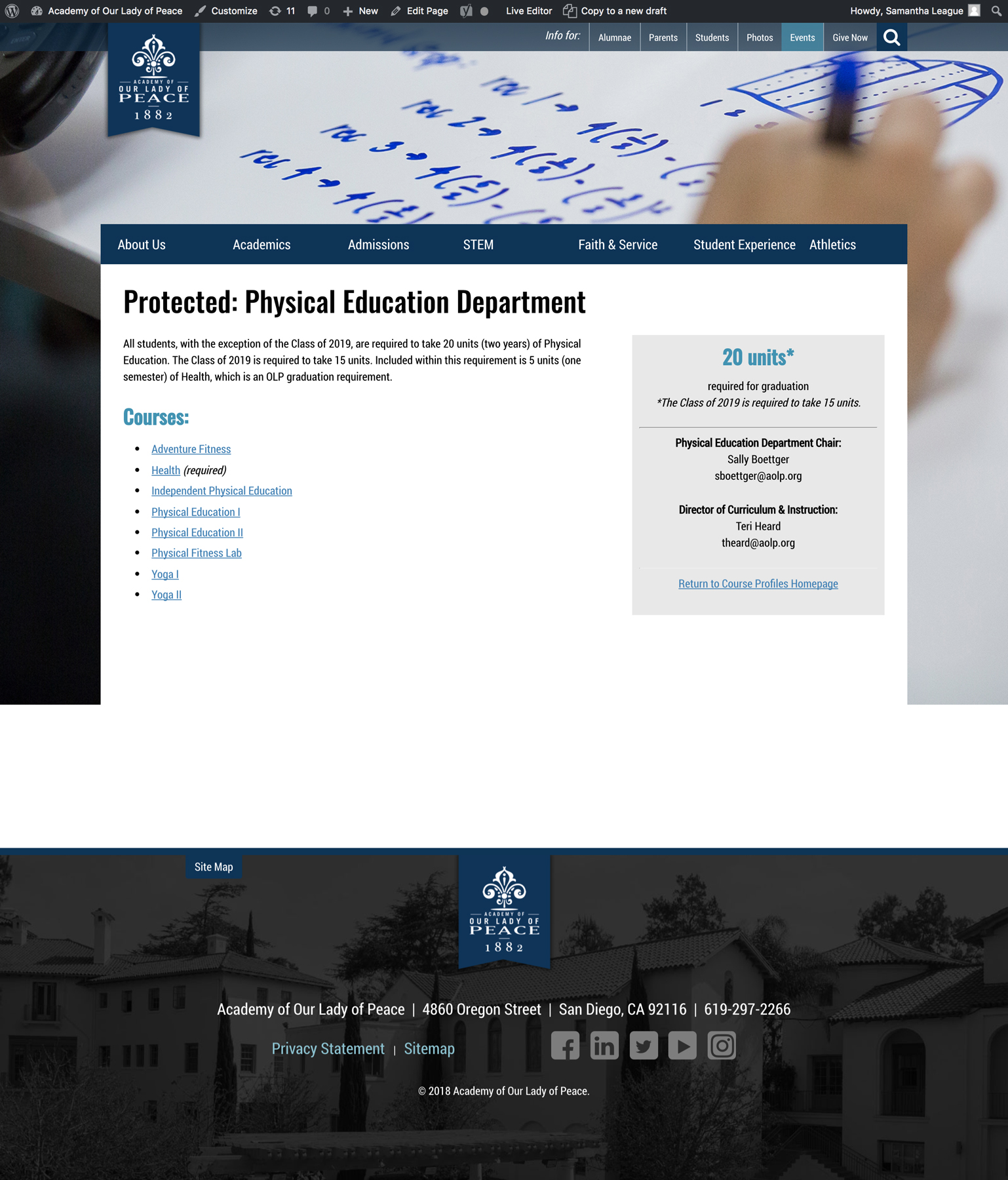
Each department page is organized in a way that makes the most sense to that department. For example, English is organized by grade level because students are required to take certain courses every year; Physical Education courses are organized in alphabetical order because students can take any course to fulfill graduation requirements; and Visual & Performing Arts is divided into visual, performing and interdisciplinary arts, simply because that department is the largest and students tend to cluster their studies by those categories.

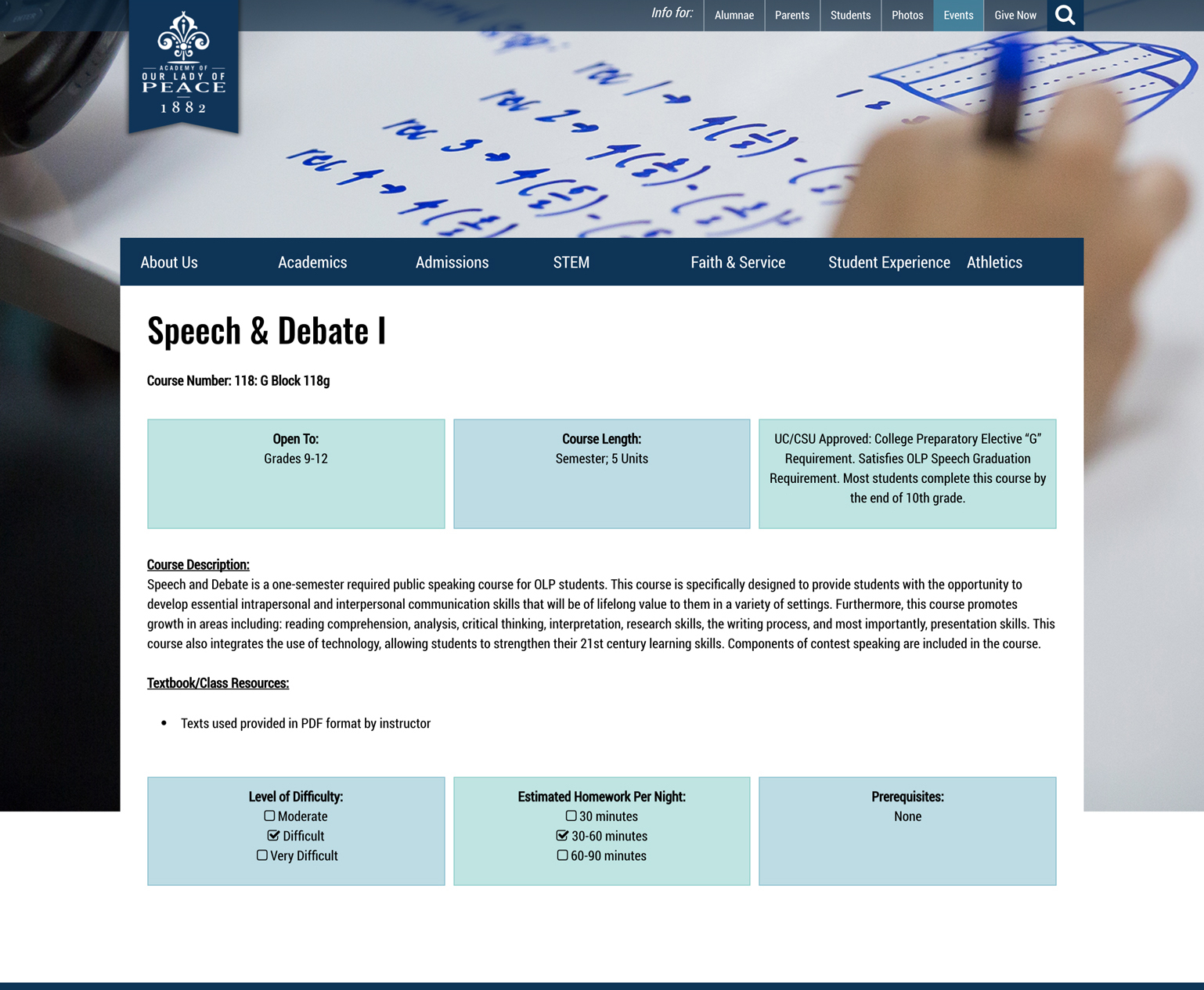
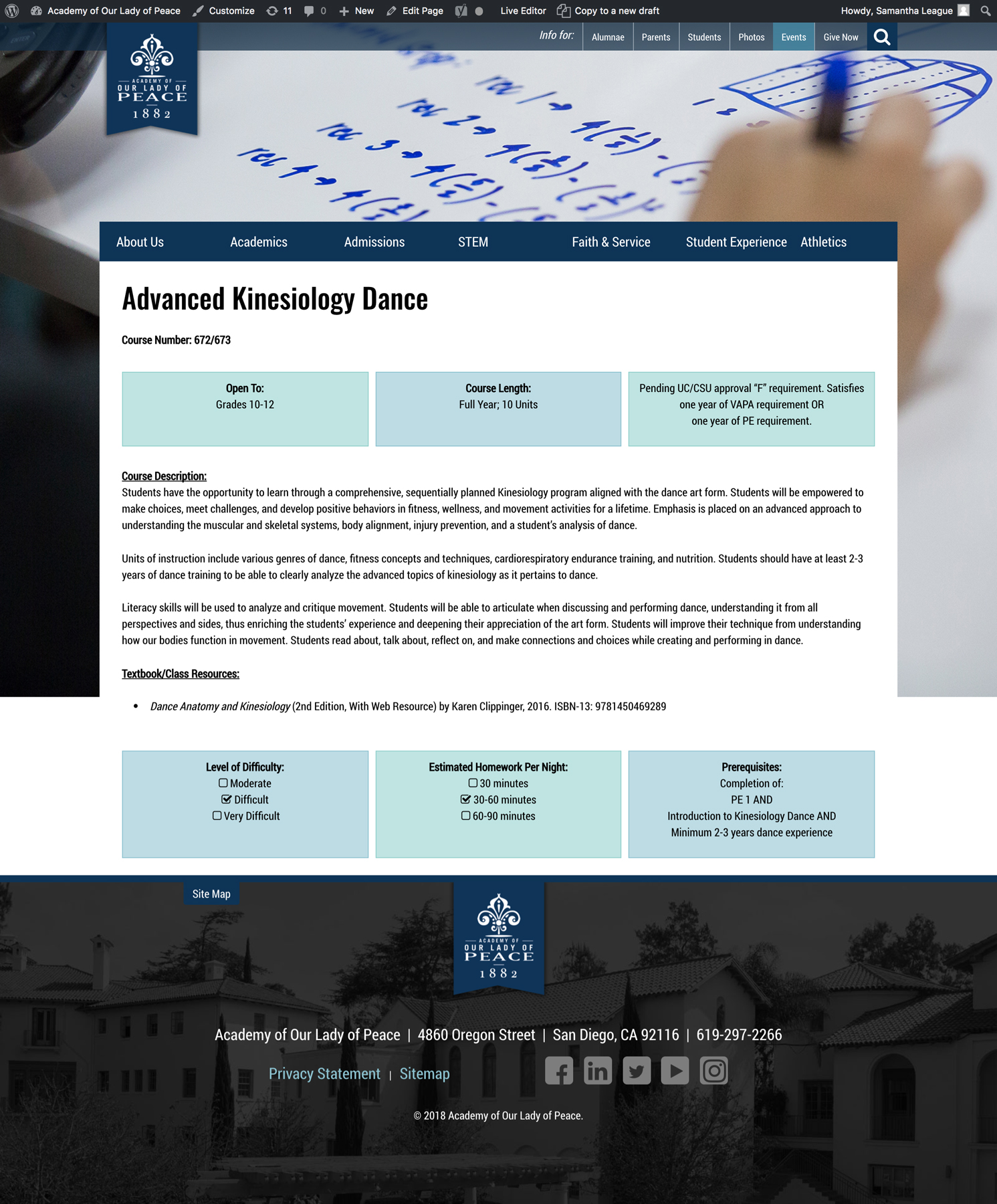
Every course page is organized in an identical format. The title & course number is the top, followed by a three-column table that notes 1) what grades may take that course, 2) how long the course is and 3) how that course meets graduation & curriculum requirements. The middle of the page includes the course description and required textbooks. Finally, the page concludes with another three-column table that notes 1) level of course difficulty, 2) estimated homework per night and 3) prerequisites.

So far, I have created and designed 144 pages for this section.

You may notice that every page has the same background image. Every section on our website has the same background image as well – all "Faith & Service" pages have the same background, all "Athletics" pages, etc. Although Course Profiles will technically be under "Academics" vs. its own menu, I wanted to make it clear that these pages belong to the Curriculum Guide in case they are found through our website's search bar. I chose this image because 1) it clearly conveys "academics," 2) shows off our new whiteboard desks and 3) can be used for a few years since it doesn't show a student or teacher's face.

All pages in this section, along with most pages on OLP's website and my own, were designed with SiteOrigin's Page Builder plugin.

Maintaining Pages

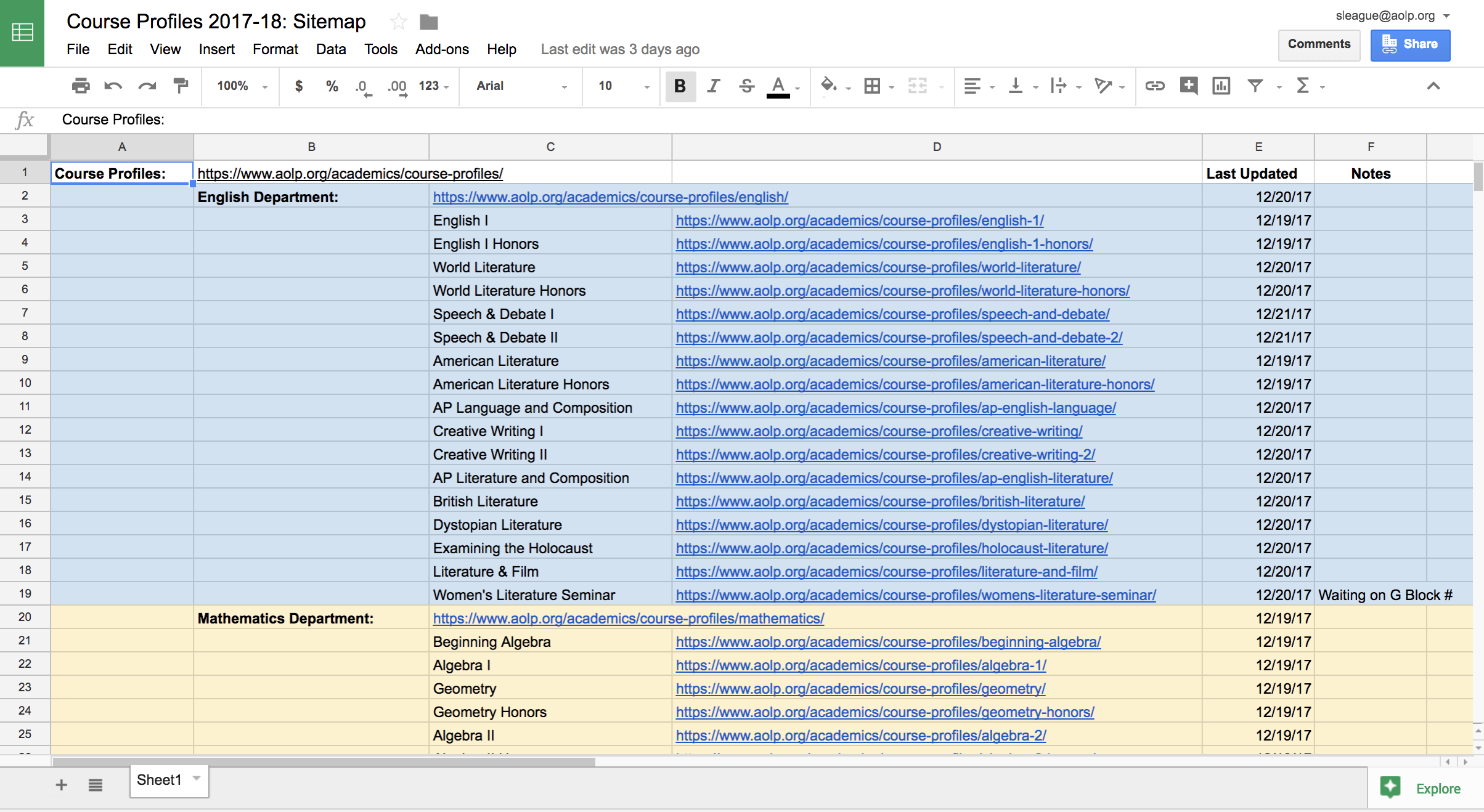
Drafting the Curriculum Guide is a big annual project that requires input from virtually every teacher. To track changes to webpages, and to give everyone easy access when they need to find a specific page, I created a "Sitemap" in Google Sheets. It's divided by department, contains every URL, a column for "last day modified" and a column for "notes."

Scroll to top